


Rosemary Clooney's Success Amid Struggles
.jpg?sfvrsn=eac11580_1)
Rosemary Clooney’s legendary career in film, radio, and TV is chronicled with humor, heart, and poignancy in Tenderly: The Rosemary Clooney Musical.
Returning to the Playhouse following a previous extended run in 2014, this musical biography written by Cincinnati-based songwriters Janet Yates Vogt and Mark Friedman contains a bevy of timeless hits such as Come On-a My House, Mambo Italiano, and Hey There. However, the show, featuring only two performers, ventures beyond the songs to tell a deeper, relatable story of success amid personal struggles, particularly Clooney’s battles with addiction and depression.
“There are so many layers to her story,” Vogt said. “Of course, there is her unique and lush voice that captures the ear from the very first word she sings in every song — truly mesmerizing. But behind that voice is a compelling story of a woman who meets some very difficult challenges in her life head-on. Rosie was always very forthright about sharing those moments, and I find so much inspiration in her honesty. Her ability to push forward as she reinvented herself, both personally and professionally, continually broadening her horizons as an artist and singer, is a life lesson for all of us.
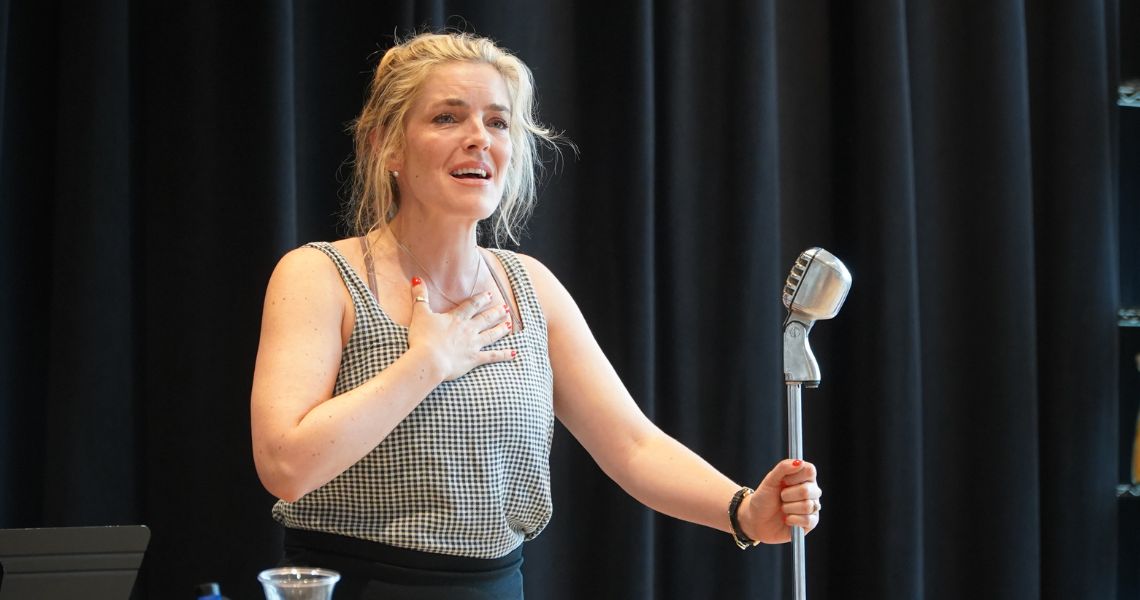 Rehearsal photo featuring Mollie Vogt-Welch (Rosemary Clooney)
When Vogt and Friedman conceived Tenderly, which had its 2012 world premiere at the Human Race Theatre Company in Dayton, Ohio, they were intentional about capturing the broad scope of Clooney’s journey accurately and genuinely.
“Our first goal was to read and watch everything we could related to Rosie,” Friedman said. “We talked to family members, friends, and visited places that she loved in Maysville and Augusta, Kentucky, (as well as) Cincinnati. We talked to her professional contacts and others in the business. We wanted to be as accurate and as true to her life as we possibly could be, pouring over her two autobiographies. Her music, her relationships, her successes, and, yes, her lowest moments, all gave away to a huge rebirth, resulting in her reinventing her career and her popularity as a performer.”
Using Clooney’s autobiographies as a launching pad, the duo came up with a framing device that allowed the storytelling to become more candid.
“Very early in the infancy of the piece — before anything was on paper — we decided to set the entire story within Rosie’s therapy sessions,” Vogt said. “With that concept in place, the conversations — very real ones that Rosie experienced — formed the basis of the script with the thread of the true and life-long connection between the Doctor and Rosie and her deep respect, admiration, and gratefulness for him.”
Vogt said that this led to a surprising connection during the musical’s development. “The songs that Rosie recorded really were the songs of her life. They slipped into the storytelling as if they were always meant to be there. This all came together to reveal Rosie’s legacy as an iconic singer and a life story that still rings true today, (which) so many can relate to and one that inspires so many.
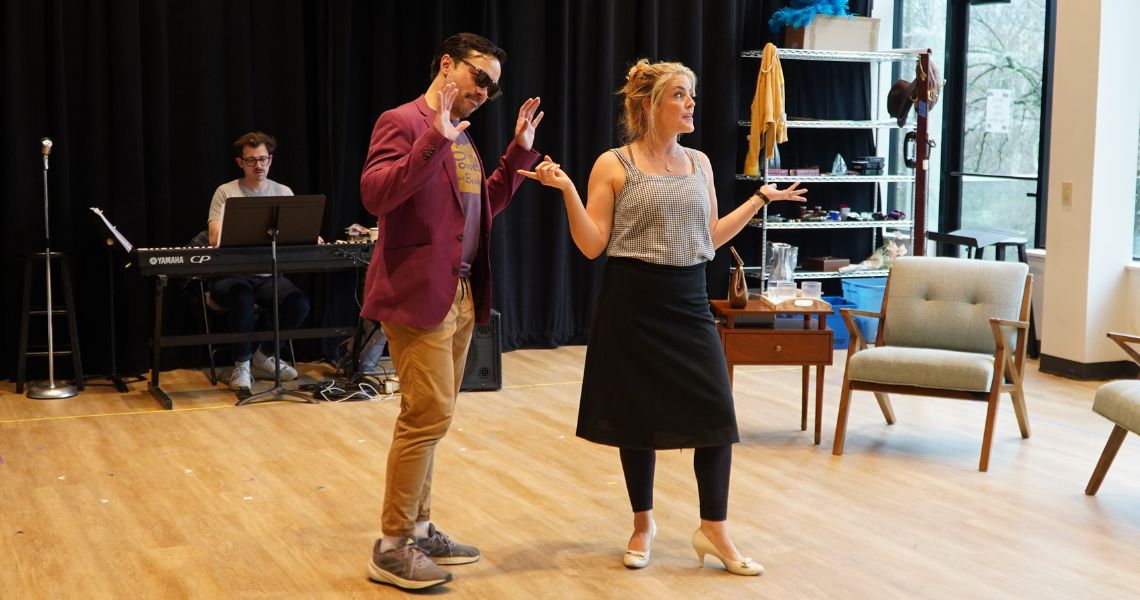 Rehearsal photo featuring Sam Simahk (The Doctor/Others), Mollie Vogt-Welch (Rosemary Clooney)
Michael Marotta performed in the 2014 Playhouse production and now returns to direct it. Over the years, he has been associated with numerous Tenderly productions as both actor and director and has taken away many valuable lessons.
“I have learned so much from doing this show,” Marotta said. “From the women whom I’ve played opposite and examining their interpretations to the audience who adored her and had to learn things they were not prepared for. From directors who shared insights that were new to me or exposed misgivings that I had to challenge. Being an old Hollywood film buff, I consider myself well-versed in the rights and wrongs in telling a story like this one.”
Vogt continues to find nostalgia to be a driving factor for theatregoers. She’s proud that Tenderly invites a special opportunity to look back on a bygone era.
“I think it’s lovely to be reminded of past times and eras whether you personally experienced them or not,” Vogt said. “And in particular, a musical like Tenderly, that largely features songs from The Great American Songbook, transports the audience to a different time and place — as much through its dialogue as its music — maybe even more so through the songs that are filled with sheer poetry in their lyrics and melodies that capture the listener with their beauty or whimsy. There’s an authenticity in each note and word that feels effortless. It’s hard to define the magic of each song — how it moves the listener and draws the audience in — in a warm, nostalgic, and comforting way.”